







 WhatsApp


Our partner Decision Wise's research on what builds employee engagement clearly shows that leaders have a significant impact on employee engagement.
Engaging leaders can sometimes be individuals who by their very nature motivate and engage others. They may have certain skills, personality traits or competencies that spontaneously draw people into an engaging environment. Can these engaging leaders create an environment where others choose to be engaged, hence high employee engagement. You bet yes! As a leader, you have a very important influence on the engagement of those you lead. When your people choose to be engaged, you probably have more influence than anyone else in your organization. Don't feel this as a pressure, but this is the situation...
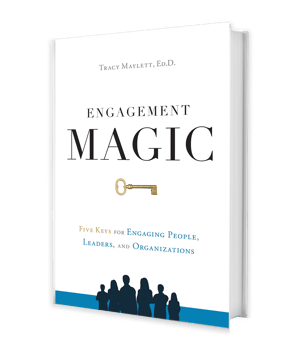 Here's the good news: while some may think employee engagement is a myth , Decision Wise'sresearch for ENGAGEMENT MAGIC shows that the more engaged you are as a leader, the more likely your subordinates are to be engaged too!
All the researchthat has been done to see if there is a relationship between the level of engagement of managers and the level of engagement of their subordinates clearly shows that the more engaged managersare in their work and workplace culture, the more engaged their teams are. You already see this intuitively in our daily lives. Now science and statistics support this intuition.
The team conductingtheENGAGEMENT MAGIC study analyzed data files containing employee engagement survey results from twenty-two companies. After excluding all managers with fewer than four subordinates, they were left with survey responses from 2,300 managers and 18,913 lower-level employees. A careful analysis of the engagement scores of both groups (managers and employees) showed the following results:
- There are four "categories" or levels of employee engagement. In the study, 35 percent of executives fell into theFully Engaged category , 50 percent were classified as Significant Contributors, 13 percent fell into the Opportunity Group , andonly 2 percentwere in the Completely disengaged category .
- The results fornon-managerialemployeesshowed a similar breakdown, with 27 percent of employees being Fully Engaged, 49 percent being Important Contributors, 20 percent in the Opportunity Group and 5 percent in the Completely Uninterested category .
- When the manager was in the "Fully Engaged" category instead of the "Important Contributor" category, the number of "Fully Engaged" employees increased by 50 percent.
- The results of the study show that engaged managers influence the engagement levels of their teams, and engaged managers' teams are more engaged.
 The research also showed that managers and executives in the US are more engaged than they have been in the past. In 2018, managers and executives in the US showed the highest levels of engagement across all positions, and engagement has increased significantly over the past five years. But interestingly, most managers didn't realize how critical their own engagement was to their team's engagement.
The findings of a study on the impact of a manager's engagement on the engagement of his or her team emphasize how critical this relationship is. When a manager's level of engagement increased by just one percentage point from the survey a year ago, that manager's employees were 213% more likely to be engaged.
So is it important for a leader to be a leader who creates commitment ? According to both our intuition and the results of research, this is clearly true: Engaging leaders have engaged employees. Spot....
So the key question is: Can managers learn to increase their own and then their employees' engagement? Yes, being engaged is something that can be learned and it is actually a competency that you can develop. Employee Engagement Training for Managers serves this purpose.
What do you think about this? How much do you think a manager's commitment or lack of commitment affects employees? You can share your views with me via the form below.

Other Blogs You May Be Interested In:
7 Definitions of Employee Engagement
The Formula for Building an Engaged Workforce
Creating Employee Engagement is a Leadership Competency
Why the Concept of Employee Engagement Should be Taught at the First Recruitment?
Related Articles