







 WhatsApp


When you decided to read this article, do you realize that you are making a deal right now? Not a formal agreement but you have decided to read the article and naturally you have certain expectations. It's a "brand" agreement, and it's an agreement based on your perceptions about me, about the Success Programme, or about the source from which you found this article...
In addition to all these thoughts, beyond the information I have promised to give you in this article, you are also filling in some other expectations from your past experiences into this agreement in your mind. This "psychological" deal is formed spontaneously when the expectations you set in your mind in exchange for the time you sacrifice to read this and your assumption that this article is worth reading come together. Thanks for your trust, I will do my best!
Unfortunately, if I don't fulfill these expectations, you will be unhappy. So now there is a pressure on me; I have to fulfill your expectations, but most probably we don't even know each other! So what are your expectations? I'm guessing you want to learn something, maybe you assume you're going to get something useful out of it. You probably have an expectation of readability, at least if I can provide you with useful content, maybe you will tolerate some awkward sentences.
 The point is that you have expectations and these expectations affect your experience. So you will have an experience in direct proportion to your expectations. For example, maybe you're going to be disappointed when you read this perfectly reasonable article because a friend recommended it as a "life-changing" article. Maybe a smartass friend sent it to you so that you could make fun of it together about how funny it was, but as you read it, I managed to exceed your expectations a bit and you were satisfied with the time you spent. To make a long story short, it is impossible for experiences to be the same for everyone, it is a myth that experiences are objective, so we have to start embracing subjective experiences (experiences that are unique to you).
In fact, your whole life is a series of expectations that have been met, exceeded or violated. And your "life experience" is a combination of violent and unexpected experiences that dramatically shape your attitudes, and persistent experiences that build up over time. You can even describe your experiences as the difference between your expectations and your reality. I go into a performance review expecting the worst to happen and instead I get enthusiastic praise and a raise; my expectations were exceeded. Experience? Very positive.
On the other hand, let's say that, as usual, I was expecting a big Christmas bonus so that I could make a down payment on the car I wanted, but I only got a free subscription to a sports club as a Christmas bonus. You could argue that I am better off than I was before this bonus, and circumstances dictate that I should be happy. But most people would say that the result is certainly not happiness. Also, not all experiences occur with equal intensity. For example, the experience of finally seeing my favorite singer live in concert in my home town will never come close to the importance of the experience of my best friend's health. So each experience has its own weight.

And there is one last piece of the puzzle. None of this comes out of nowhere. You enter each experience with the sum total of your previous experiences. Are you generally a happy person? A partially bad experience won't change that and you may even remain positive on the net afterwards. Are you a pessimistic person? A good experience may not be enough to lift you out of the gloom.
If we put them together to measure the experience, we have your expectations (B) and the reality of how well they were met, the outcome (BS), all multiplied by how important that moment was for you (S) and added to your general state (GD). More precisely:
Experience=(T * B * BS) + GD
Try it! Start with something easy, like the last movie you saw. How would you rate the movie?
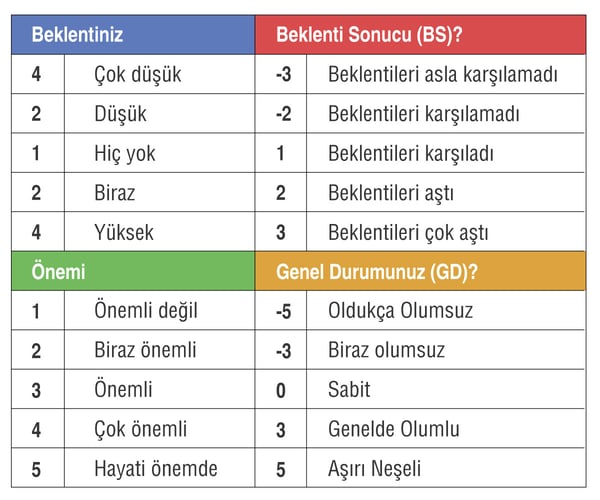
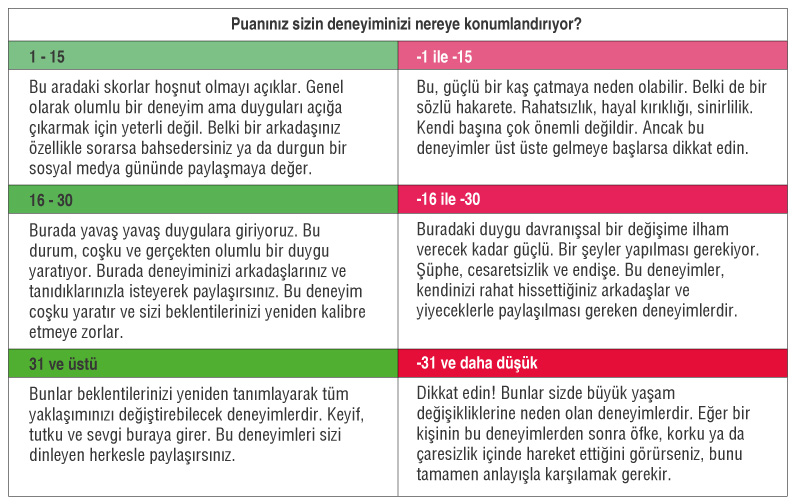
So what makes this equation different from a magazine quiz? With this equation in hand, you can now identify pain points in your organization. Could it be that some departments or some demographics are having completely different experiences? Do you need to make some minor adjustments or a complete overhaul to meet their expectations? Even if your employees are having good experiences as a team, could their personal experiences be bad? For example, identifying that the experience of a new mom is different from that of a single recent graduate, or that there are practices that are good for the customer but bad procedurally. Maybe someone is failing or maybe you have too high expectations.
If you've done all this work and you've found an aspect of your business that is not a Greek tragedy, but something that is consistently failing to meet expectations, you've actually hit on a single issue that will wear you and your business down in the long run. It's much easier to fix that, but if this experience goes on for a long time, you get to the point where you're so frustrated with the wide variety of problems that arise that you can't understand what went wrong anymore and you can't get out of it by fixing just one thing. It is much easier to see these problems coming and make corrections.
Now that you understand that defining and measuring expectations is key to creating an elite employee experience, give this formula a try for some work-related scenarios! Here are some examples to help you quickly identify where your expectations are not being met.
Scenarios
- Your most recent performance review
- Your previous job,
- Your relationship with your boss, spouse, children or colleagues,
- The last project you completed,
- Your last disagreement with a colleague,
- Your last salary negotiation.
We welcome you to rate your experiences and share your feedback with us. you can use the form below to contact us.


Other blogs that may interest you:
What is the Difference Between Employee Satisfaction, Engagement and Experience?
Why Your Customer Experience (CX) Actually Depends on Your Employee Experience (EX)
Employee Experience: It's More Complex (And More Important) Than You Think
Related Articles