







 Chat
Chat

.png)
Shawn Murphy, co-founder and CEO of Switch and Shift, interviewed Tracy Maylett and Matthew Wride, authors of Employee Experience and principals of our partner Decisionwise, about their new book "Employee Experience: Attracting Talent, Retaining Top Performers and Achieving Results". I would like to share with you the parts of this interview that I think will be of interest to you.
Companies' Growing Interest in Employee Experience:Murphy: What's behind the growing number of organizations that are starting to evaluate employee experience, and how do we know if this is just another management fad?
Maylett: We owe a lot of this momentum to recent employee engagement moves. Organizations have discovered the clear link between engagement and operational performance. Engagement has become more than a "nice to have" idea supported by HR. If something has a link to financial metrics, ROI, profitability quality, attrition and so on, it is likely to be of interest to the entire organization. Employee experience, or EX, is the sum of employees' perceptions of their interactions with the organization they work for. Given these perceptions and metrics, organizations have begun to realize that engagement is only one part of the people equation. Sometimes the Employee Experience-EX is positive, sometimes it is negative. But there is always an experience, and that experience directly impacts performance. How employees perceive their own experience in the organization is a strong predictor of organizational performance. Since emphasizing performance is by no means a passing fad, it is important to understand all performance-related indicators. Understanding the employee experience underpins business performance.
Read Our Related Blog: What is Employee Experience?
Employee Experience Trends:
Murphy: What trends do you see in the connection between employee experience and customer experience?
Maylett: There's been a lot of interest in companies to focus on creating a great customer experience (CX). There is no doubt that customer satisfaction is the ultimate bottom-line driver. However, today's organizations spend millions on unnecessary efforts to create profit-enhancing CX. Most companies fail to realize that their employees create the customer experience. Employees are the face of the company. Customer Experience (CX) is a direct result of Employee Experience (EX). CX = EX. We call this the "Law of Conjugate Experience". Employees deliver a customer experience that matches their own experience within the organization. Some companies are now realizing that focusing solely on customer experience (CX) is an outdated attempt to delight customers.
Read Our Related Blog: What is the Law of Conjugate Experience?
Wride: The trend over the last few years has been to focus on the customer experience, ignoring the employees who are interacting with customers on a daily basis. We remind business leaders to build on the foundation of a well-functioning employee experience, rather than obsessing over the fact that a customer spent 32.3 seconds on a website this year compared to 36.9 seconds last year. If you want a unique customer experience: You need to start by creating the environment that nurtures and supports an engaged workforce.
Expectations on Employee Experience:
Murphy : Let's talk about the role that employee expectations play in the employee experience. What are the other important factors?
Maylett: Numerous studies in clinical and organizational psychology show that expectations are the foundation of relationships. In every relationship, whether between spouses, parent and child, boss and subordinate, or company and employee, there is an "Agreement". This agreement consists of a set of expectations that cover all parties. Some of these expectations are explicit ("You will work X hours a week and I will pay you Y salary") while others are implicit ("I will work extra hours for this project because the company will take this into account in the next promotion period") This set of expectations or agreement is sometimes reinforced, sometimes violated or renegotiated. Our research shows that the impact of honoring or not honoring this agreement has a greater impact on the relationship than the impact of the environment in which the relationship takes place.
As far as the workplace is concerned, someone's commitment to their job is less about foosball tables, Friday dinners, social activities and salaries and more about whether their expectations are met. Much of our perception of EX depends on how well expectations are met. If expectations and realizations are not aligned, there is an expectation gap, which leads to disengagement.
Wride: Expectations are the atomic elements that make or break relationships. But we don't spend enough time thinking about them, worrying about them. Instead, we focus on doing the "real work" of the day - meetings, announcements, schedules and financial forecasts. Of course, these are also very important, but not to the extent of sacrificing harmony with one's team.
Mutual Responsibilities in the Employee Experience:
Murphy: Whose responsibility is it to create a positive employee experience? Top managers? Middle management?
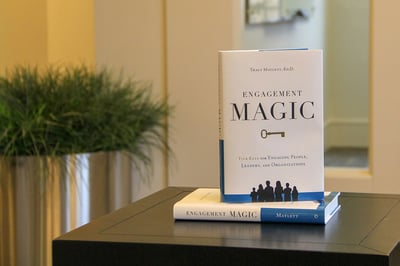
Maylett: In our book "ENGAGEMENT MAGIC: 5 Tricks to Keep People, Leaders and Organizations Engaged", we say that engagement is a 50/50 ratio. The company is 50% responsible. The organization must create an environment that encourages employees to choose to be engaged. But it is still a choice and employees need to choose to be engaged.
Similarly, half of the responsibility for the employee experience lies with the employees. Most leaders can point to employees who consistently choose a negative employee experience despite management's best efforts, (remember that EX is all about perception) but the organization is still responsible for the other 50%.
Managers and supervisors are the foot soldiers with a direct connection to employees. They are the beginning and the end of managing the internal employee experience-EX. In other words, we are ALL responsible for creating and maintaining a positive employee experience (EX).

Values and Employee Experience:
Murphy: What is the role of the Employee Value Proposition (EVP) in engagement?
Wride: The Employee Value Proposition is just one part of a well-functioning employee experience. We call it the "brand deal". The EVP examines your company's brand in relation to your current and future employees.The expectations of what the organizationneeds from its current and future employees are intertwined with what employees expect from the organization. To the extent that an organization's EVP is a bridge that bridges the gap between organizational needs and employee expectations, it helps the organization attract and retain talent that will help it win.

Leadership in Employee Experience:
Murphy: Where do leaders go wrong when improving the employee experience?
Maylett: Leaders make mistakes when they do not consciously design an employee experience (EX). When leaders neglect the employee experience (EX), ignore it, or allow it to happen unconsciously without an agreed upon employee experience design, a poor employee experience is often created. The employee experience (EX) must be consciously created. The employee experience (EX) is like a spontaneous culture. It happens whether it is planned or not. When an organization purposefully creates a positive employee experience (EX) rather than allowing it to happen on its own, the EX is more likely to reflect the positive values of the organization.
Wride: It's just like parenting. When I first became a parent, I was a bit arrogant, I thought I had a natural ability to be effective, which was wrong, and I had to work at it and consciously make it a focus. Most leaders are already overachievers, which leads them to believe that they are competent across the whole spectrum. They fall into the trap I fell into with parenting. They make the mistake of believing that because of their previous success in other areas, they have an innate ability to manage, motivate and engage people. For a small percentage, this may be true. But what our employee survey responses show us is that a clear majority of leaders need to improve their people skills.

To design your Employee Experience consciously, please send me your questions via the form below.
Related Articles