







 Chat
Chat


March 2020 went down in history as the month that changed everything. In a matter of weeks, the Covid 19 virus spread rapidly around the world, affecting governments, stock markets, healthcare systems, education systems, entertainment, travel. It affected everything. Since that day, routine life has been turned upside down all over the world.
There is a lot of speculation about what daily life and business life will be like in the coming years. Even though we have different opinions about this, I think we can agree that the world will be very different. It is vital that organizations quickly plan how they will deal with these differences. Below are some suggestions to help organizations adapt to and navigate the challenges of both current and future changes.Doing Business in an Escalating Pandemic Requires 200% Accountability.
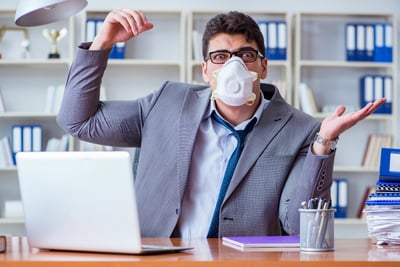
People who had stayed indoors during the first months of the pandemic came out of their homes at the beginning of the summer, when the virus was still lurking. They wanted to go back to work and their old lives, thinking that precautions had been taken, that the spread of the virus was now under control. Of course, in the new normal, the risk had not disappeared, but overwhelmed people simply threw themselves out. While some went completely back to their past lives, most of us made some permanent changes in our meeting people and social habits. We had to eliminate handshakes, hugs and kisses. This may have been very annoying, but it was not too high a price to pay for an armistice with the virus.
But with the end of summer, this truce came to an abrupt end. The virus is on the attack again. With the increase in cases, some organizations have decided to continue working from home, while those working in some sectors continue to work in the field by taking various measures due to the nature of their work.
In this way, working on the ground despite the pandemic means that employees and customers also accept a reasonable amount of risk. If you are a manager in a field-based organization, your job at the top is to make sure that employees and customers feel safe enough, within risk tolerances, to do business. If you don't put this at the highest level, your customers will walk away from you because they don't feel safe enough to do business with you, and likewise employees will feel less committed to their work because they don't feel safe, and there will be many complications. Organizations that have to work in the field under the current conditions and want to do their best work in the new normal need two things;
- New procedures on how they should behave in the workplace under the current circumstances and
- 200% culture of accountability...
 I see a lot of organizations developing procedures to fit this new situation. They are implementing social distancing and hygiene rules. For example, they are making changes to workspaces and virtualizing meetings to strengthen social distancing. Hygiene warning signs and related cleaning products are in many places. However, none of this is successful without a 200% accountability culture. Why 200% accountability and not 100%? 200% accountability means that each employeeis 100% responsible for implementing the new norms andprocedures, but also 100% responsible for implementingthat standard with everyone around them (regardless of title or position).
The other day I was in a workplace that maintains social distancing. Within a few minutes, I saw numerous violations of procedures. People were standing inches away from each other, shaking hands, etc. I could see that those who were being touched were actually very uncomfortable, but they didn't say anything. They didn't even open their mouths, especially if the person violating social distancing or other hygiene rules had a higher status than them! Others were worried about offending their friends and did not warn them.
Having procedures alone in a company is meaningless. It is only when they become norms that are adopted by everyone that the desired results are achieved. 200% accountability means that employees have the ability to respond appropriately if they see shortcomings or malpractice in any of the new norms. If people are able to confront norm violations immediately when they occur, norm change has taken place. A norm cannot exist unless it is "normal" for everyone, regardless of their level or position, to be warned when they make a mistake regarding the new norms.
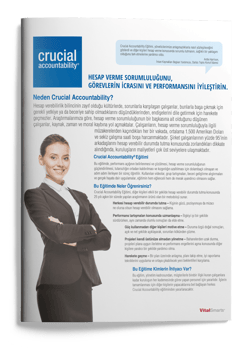 Critical Accountability Training Brochure

Make customers and employees feel safe by making the non-negotiable negotiable.
Effective leaders know that they must not only ensure that their customers and employees are safe, but that they must also make them feel safe. The best way to help people feel safe is to make the non-negotiable negotiable.
First and foremost, let your customers know clearly what you are doing to reduce the risk of the virus spreading in your company. It is more effective to do this through human contact (by phone or teleconference) than through mass emails. Measure compliance with the new standards in your company and be honest with your customers about how well (or badly) you are doing. At the end of the day, customers will not trust you unless you are trustworthy. Transparency is the foundation of credibility.
Second, give your customers different trading options. People feel more secure when they have choices. Make every possible transaction available online. Many companies have already found that simply recognizing the seriousness of security concerns and giving the customer choices surprisingly leads to much higher customer loyalty. Join them.
Build behaviors now that will prepare your business for the next pandemic.
Viruses have not completed their evolution. In the future there will be Covid-20, Covid-21 or some other virus. Therefore, we should think of this pandemic as a rehearsal for the next one. Viruses evolve through random mutation. We humans, on the other hand, evolve. But we usually need to use our brains to do so. We must evolve by choice, not by mutation. Let's see all this as an opportunity to develop new models to combat threats, not just as an inconvenience caused by a virus, a new piece of DNA. If the next biological threat is going to have a similar toxicity, we need new models of living and doing business that will routinely come to terms with it. If we don't make risk reduction a way of life, then next time, and the next time, the only alternative will be to "eliminate the risk" and "bear its unbearable costs". It will become very difficult to live a life like this.
Crises always come with opportunities.
There are new norms about how we work, how we serve and care for customers, and how we connect with each other. It is time to accept this situation and start implementing these norms as soon as possible, but most importantly, it is time to create a 200% accountability culture to ensure that these norms are implemented in companies without interruption....
This crisis, like every crisis, offers us new opportunities at work and at home. The productivity of employees working from home has increased even more. Families have become closer than last year. We feel more involved in our children's lives than ever before. We try to understand each other's needs more. We are more generous in sharing our concerns.
Seeing and implementing these opportunities requires leadership.
Other Blogs You May Be Interested In:
How to Manage Remote Teams?
Working from Home or Skipping Work?
3 Fundamentals of Successful Online Presentations
How to Make Online Meetings Effective?
An Easy Way to Maintain Social Distancing at Work
Related Articles