







 WhatsApp


As human beings, we are very inclined to categorize and stereotype things in order to understand them, to make sense of them. In fact, this natural tendency to stereotype sometimes obscures what is really going on and prevents us from seeing the truth. If you are a fan of optical illusions or magicians' illusions, you know how our brains use such patterns and "shortcuts" to distort reality.
The reason for this is actually energy saving. If a pattern is predictable, it means that our brains have to work less, and nature loves to conserve energy. You might be thinking, what does this observation have to do with our organization's Employee Experience (EX)? If, as I mentioned, we follow our brain's preferred shortcut, we may naturally tend to create an "Employee Experience" that is almost the same for every employee. As I mentioned, we are programmed to look for repeated patterns and processes. However, this tendency can create a bias in us that goes against the most important goals of our organization.

Now think about it: Your organization's Employee Experience (EX) is the sum of the various conditions that surround and influence your employees, both behavioral and social. In other words, your EX is the unique social environment in which your people do their work. When designing your EX, your goal is to create an EX environment that supports your organization's key objectives. For example: if you want punctuality in your engineering team, then you should design your engineering team's EX to encourage punctuality. If another team's value depends on creativity, then you should design that team's EX with working hours that allow them to work without interruptions so that they can express their creativity. A second lesson from these two examples is that the employee experience should not be the same for every employee. Of course, the values and ethics of the organization should certainly remain the same, but other components need to be differentiated if you want to get the most out of the talent in your company.
With these ideas in mind, the next step is to try to understand your organization's EX. Every organization has a unique EX. Some are inherited from the past. Others are designed with control. But the majority are acquired randomly or an EX has been forced upon the organization by its current leaders. You cannot shape and improve your EX if you do not have a clear understanding of your starting point.
How to Better Understand Your Employee Experience
Analyze Survey Data
As a way to better understand your current EX, we recommend analyzing the survey data you collect from your employees. Instead of focusing on traditional groupings and comparisons in the survey, we suggest you dive deeper and use the data to help you understand why and how your employees have different Employee Experiences within your organization. The key question to look for in your employee survey data is: Do my employees have different Employee Experiences and if so, why?
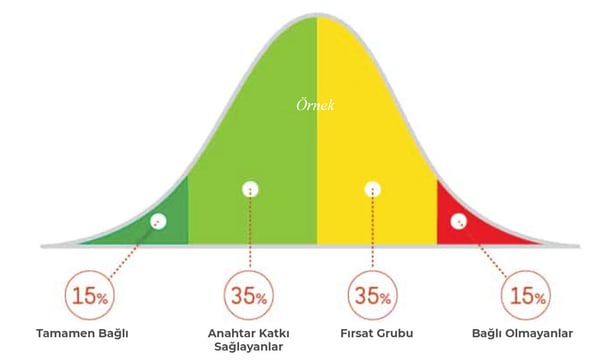
One possible way to address this process is to divide your employees into four groups based on how positively they view your organization. We recommend using a traditional bell curve.
The highest scorers can represent the top 15%: These are the fully engaged employees who give your organization the highest score. They are the organization's most enthusiastic champions and their enthusiasm is tangible and contagious.
The second group could be the next 35%: This group represents your key contributors. These are the "strong and ready" employees who meet performance expectations. They get things done, but spend limited time on innovation, improving processes or breaking the status quo.
The third group: the next35%. This is the section of employees where there is a strong opportunity for improvement. They often feel underutilized, use too many working hours to fulfill personal needs, do just enough to get the job done and not get into trouble.
The last group is the rest of your employees, and this group represents those who are not engaged at all: These employees are bored and frustrated, say negative things about the organization and tend to blame others for their own mistakes. Once you have parsed your employees as suggested, the next step is to look at the following three criteria.
Look at Three Different Types of Benchmarks
Criterion #1
Compare each group's overall positive rating of your organization. What do you see? What do you notice about each group's Employee Experience? Next, try to find out who is in these groups (not by name, but demographically). For example, are they mostly women, engineers, production line workers, etc.? Try to understand the forces that shape and mold these groups.

Criterion #2
Based on all the results of the survey, find the top three questions for each group. These are the questions for which the group gave your organization the highest positivity score. Compare these questions across groups. Ask yourself why my top group is interested in certain questions as opposed to what other groups have indicated.
Criterion #3
Compare each question in your top group with how other groups answered the same question. In other words, look at the same question across all groups and see how they answered it. What are the differences? What information are you getting?
Armed with this data, you will have a picture, however fuzzy, of the current state of your EX. This will serve as a good starting point. But you can't stop there. The next step involves conducting targeted surveys that measure everything from what drives your employee value proposition to exit surveys that will shed light on why people leave.
The key here is to set up an EX data analysis plan that digs deeper into the targets on certain topics as well as achieving comprehensive results. Also, make sure that your analysis plans cover different periods and landing points in the employee's natural life cycle.
We have one last tangent. Throughout the analytical process, don't just look for the points where the data converges, but instead look for the points where the data diverges. Check for natural biases that are close to stereotypes by trying to find moments of strong differences and then ask yourself why these differences exist and what insights you can gain.
Finally, by taking an analytical approach to your Employee Experience, you will be able to discover the nature of your EX and begin the process of shaping it to create a winning organization.


Other blogs you may be interested in:
What is the Difference Between Employee Satisfaction, Engagement and Experience?
Why Your Customer Experience (CX) Actually Depends on Your Employee Experience (EX)
Employee Experience: It's More Complex (And More Important) Than You Think
Related Articles


-2.png)