







 WhatsApp


As leaders know all too well, some issues are harder to talk about with employees than others. Coaching an employee on punctuality is much easier than creating positive attitudes towards the cultures and races of your employees abroad.
Thanks to our experience in coaching programs in many different sectors, we have compiled a list of the 10 Most Common Coaching Challengesand ranked them from the most difficult to the simplest. I would like to share them with you now:
How difficult the situation is depends on the individual's potential level of defensiveness or resistance to the problem. We group these 10 problems into four areas we call "Areas of Leadership Effectiveness". These include: the person's Expertise, Performance, Interpersonal Skills and Temperament. This provides a framework that allows us to address each problem with a specialized approach.
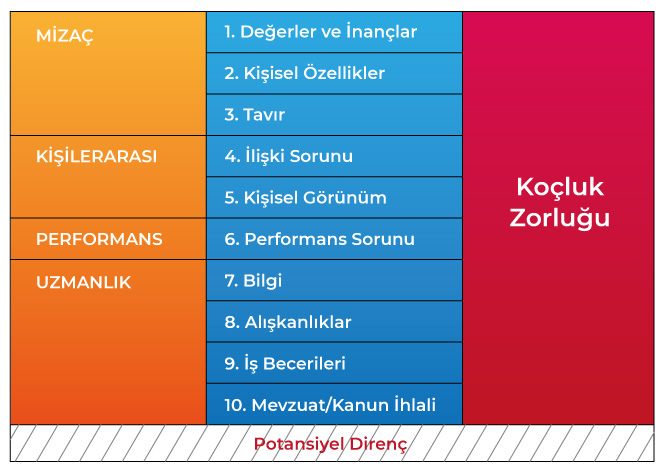
Expertise (most basic)
The situation related to a person's knowledge, capabilities and job skills (points 7-10) are the easiest to address and resolve with coaching. While corrective actions are used for regulatory or legal violations, coaching on business skills and knowledge focuses on identifying learning opportunities and following up on them in a way that progress is made. Since the problems in their area of expertise are well defined and formalized (Legislation and Procedures), they are less likely to create a defensive reaction in the employee.

We put them in item 6 on their own because there can be a wide range of reasons why a person is not performing to expectations. The approach here is to clearly define the problem, set specific targets and ensure accountability and follow-up. Sometimes the performance issue is linked to one of the other areas and these need to be addressed before setting a goal. Leaders who coach on performance issues go beyond raising awareness of a problem and start the conversation with the question "What can I do to contribute to your development?".
Relationship Issues and Personal Outlook (4 & 5) fall into this category. We use the 360 degree feedback questionnaire to raise self-awareness and provide greater insight into one's impact on others. The approach used is to find small changes in behavior that will make big differences in the leader's relationship with colleagues.


Values/beliefs, personal characteristics and attitudes (1-3) are the most difficult areas to address to help a person change. These areas, developed from childhood, form the foundation of an individual's personality. Here, a leader may have beliefs and values that do not match those of the organization, prejudices, bias or contrary attitudes that demotivate the team. The approach here is to enable the individual to decide whether he or she needs to change and to explain to him or her the personal benefits he or she will gain by changing. Sometimes a leader may have to make a decision about whether he/she is suitable for his/her current job or the organization he/she works for. The potential for defensiveness and resistance is high due to the personal nature of coaching issues that fall in the temperament area.
My questions for you are;
- How much do you agree with the list we have prepared?
- Would you like to reorganize or add new ones?
- Are there different approaches you use to address these situations?
You can share your answers with us at contact@successprogramme.com or in the form below.
 Other blogs you may be interested in:
4 Keys to Executive Coaching
Executive Coaching
6 Reasons to Work with an Executive Coach
Why Most Coaching Models Don't Work
5 Criteria for Effective Coaching as a Leader
11 Situations Where 360-Degree Feedback May Fall Short
Related Articles