







 Chat
Chat

This is the first in a series of four posts exploring the key ideas inRay Kurzweil's The Singularity Is Near . Be sure to read the others:
- We Feel Technology is Speeding Up - Because It Really Is
- How We Can Better Predict the Future by Thinking Exponentially
- Ray Kurzweil Predicts Three Technologies Will Define Our Future
"The most common objection to the basic ideas of this book is that exponential trends, like all exponential trends, must have a limit." -Ray Kurzweil, The Singularity Is Near
Much of the future we envision today is based on the exponential advance of information technology that Moore's Law makes well known. Thanks to shrinking processors, computers have gone from bulky, monolithic objects taking up an entire room to fast devices in our pockets or on our wrists. Looking back, it's hard to miss this rapid progress, because it has been astonishingly steady for more than fifty years.
But how long will this continue?
In this article, we will explore Moore's Law, the five paradigms of computing (as defined by Ray Kurzweil), and why many believe that the exponential trends in computing will not end soon.
What is Moore's Law?
"Simply put, Moore's Law predicts that both the size and price of computer circuits will halve every 18 to 24 months. For the last 50 years this has been astonishingly true." -Kevin Kelly, What Technology Wants
In 1965, Gordon Moore of Fairchild Semiconductor (later co-founder of Intel) was closely following the first integrated circuits 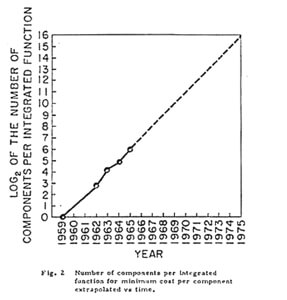 . Over time, he realized that as components became smaller, the number of components that could be packed into a single circuit steadily increased, as did the processing capability.
Based on just five data points from 1959, Moore estimated that it took 12 months (later corrected to 24 months) for the number of computing elements per circuit to double, and that this steady exponential trend would lead to much more processing power at lower cost.
It soon became clear that Moore was right, but surprisingly, this doubling did not slow down in the mid-70s; circuit production has largely kept pace since then. Today, affordable computer circuits contain more than a billion transistors spaced a few nanometers apart.
Gordon Moore's graph showing the initial progress of integrated circuits (Image: Intel)
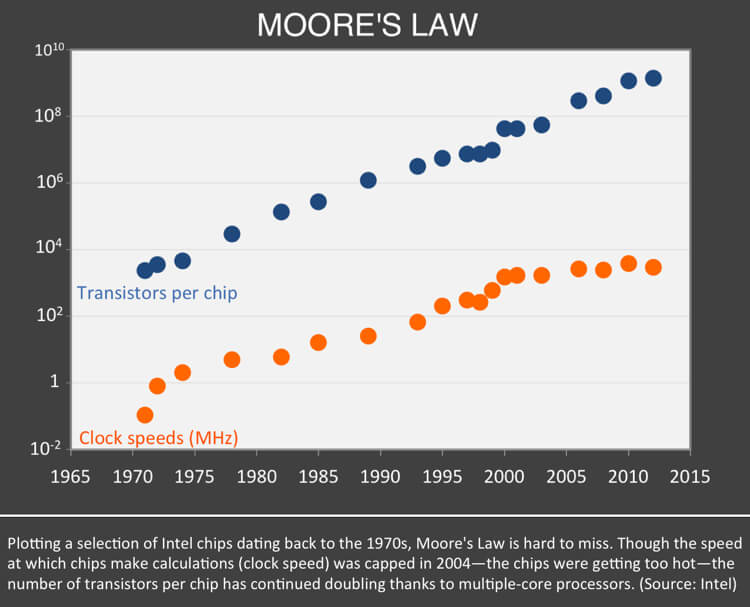
Moore's Law has been solid as a rock for years, but the rise of core technology won't last forever. Many think the trend is slowing down ; we don't know what's next.
Experts, including Gordon Moore, point out that Moore's Law is not a law, but a self-fulfilling prophecy, with companies spending billions of dollars to maintain the expected exponential speed. Since 1991, the semiconductor industry has regularly produced a technology roadmap to coordinate efforts and identify problems early.
In recent years, the circuit manufacturing process has become increasingly complex and costly. After processor speeds stalled in 2004 because circuits overheated, multi-core processors came on the scene. But now it is predicted that circuits will become too unreliable due to the quantum effect as the size approaches the atomic scale.
This year, for the first time, the semiconductor industry's roadmap will not use Moore's Law as a yardstick, but will focus on different characteristics such as efficiency and connectivity, which smartphones, wearable technology, etc. require.
With the industry shifting focus and Moore's Law reaching its limit, does this mean that the exponential progress of computing is coming to an end, or can it continue for some time to come?
Moore's Law is the Latest Example of a Larger Trend
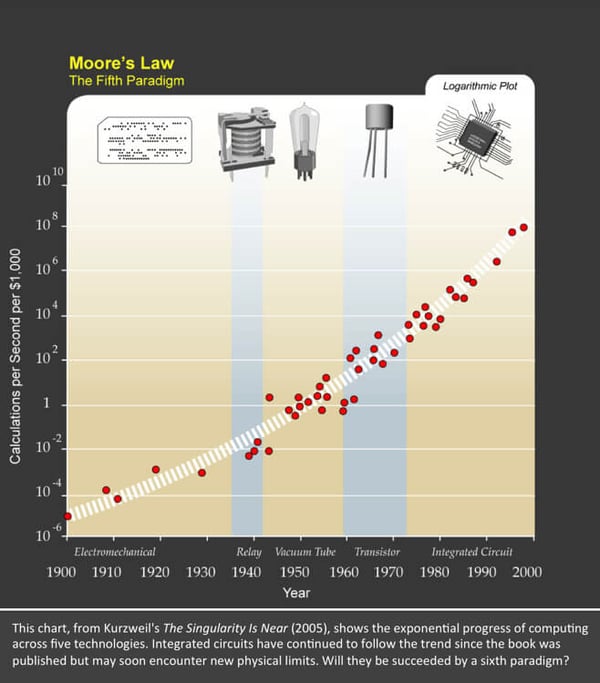
"Moore's Law is actually not the first paradigm in computing. If you look at the price/performance graph of the forty-nine famous computing systems and computers of the twentieth century - measured in thousands of dollars versus the number of instructions per second - you will see this." -Ray Kurzweil, The Singularity Is Near
While exponential growth has been seen in integrated circuits for several decades, there is a larger trend that Ray Kurzweil identified in his book The Singularity Is Near. Since the main result of Moore's Law is more powerful computers at a lower price, Kurzweil tracked how computing speed per $1,000 has evolved over time.
This measure takes into account the "level of 'intelligence'" inside each circuit - such as different industrial processes, materials and designs - and allows us to compare other computing technologies in history. The result is surprising.
The exponential trend in computing began long before Moore discovered it in integrated circuits or the industry began collaborating on a roadmap. According to Kurzweil, Moore's Law is the fifth computing paradigm. The first four are electromechanical, relay, vacuum tube and discrete transistor elements.
There May Be More
"When Moore's Law reaches the end of the S curve, expected in 2020, exponential growth will continue with the sixth paradigm, three-dimensional molecular computing." -Ray Kurzweil, The Singularity Is Near
While the end of Moore's Law has often been predicted, today's integrated circuits seem to have reached certain physical limits that are difficult to overcome, and many believe that the development of silicon circuits will stall in the next decade. But will the exponential progress of computing also come to an end? According to Kurzweil, it doesn't have to.
In his view, the integrated circuits that are the subject of Moore's Law are the latest technology in a larger, longer - and continuing - exponential trend in computing. Kurzweil suggests that integrated circuits will be followed by a new, still-in-development, 3D molecular computing paradigm (the sixth paradigm). (We will examine the technologies that are likely to succeed Moore's Law in future articles.)
Note, by the way, that Kurzweil is not claiming that the exponential growth of computing will continue indefinitely; it too has an inevitable end. Perhaps Kurzweil's most ambitious idea is that he believes this end is farther away than we think.
How Does This Affect Our Lives?
Computing is already one of the driving forces of modern life and its influence is growing. Artificial intelligence, automation, robotics, virtual reality, the unraveling of the human genome - these are some of the earth-shattering advances made possible by computing.
If we can better anticipate this powerful trend, we can prepare for its promises and dangers, and make the most of what the future holds instead of being surprised by it.
Kevin Kelly puts it well in his book What Technology Wants :
"Suppose it's 1965, and you see the curves that Gordon Moore discovered. If you believed the story they told us... you wouldn't need any more prophecies, predictions, and other details to optimize future benefits. If we as a society believed in nothing but Moore's single curve, we would educate differently, invest differently, and prepare more wisely for the amazing forces it will sprout."
To learn more about the exponential pace of technology andRay Kurzweil's predictions, read his 2001 essay "The Law of Accelerating Returns" and his book, The Singularity Is Near.
Image Credit:Shutterstock,Intel (Gordon Moore's 1965 integrated circuit chart),Ray Kurzweil and Kurzweil Technologies, Inc/Wikimedia Commons/CC BY