







 Chat
Chat


Most organizations today now recognize the benefits of engaged employees. However, many of these organizations are going in circles because they are only addressing half of the employee engagement equation. As more organizations have recognized the importance of engagement, the topic has received more media coverage and has become more scientific. Of course, as usual, being such a popular topic has had both benefits and detriments.
Harvard Professor Teresa Amabile and Researcher Steven Kramer publicized the results of a project in which they collected more than 12,000 daily entries from 238 employees at seven companies and found that about a third of them were unhappy, unmotivated or both - but on days when they were happy, they were more likely to come up with new ideas. This is, of course, a US study, but from my experience working in the business world, I would expect similar, perhaps even more negative figures in Turkey.
Articles like these provide a compelling and data-driven case for the importance of engagement and its role in performance, but they can also be confusing for organizations that don't fully understand the concept of engagement. Recently published by our partner DecisionWise, "ENGAGEMENT MAGIC : 5 Tricks to Keep People, Leaders and Organizations Engaged", recently published by our partner DecisionWise, showed that buzzwords like happiness and working harder create confusion and fuel misconceptions about what engagement is and is not. Is employee engagement about feeling happy, or is it simply about getting the job done? Not really.
It's about putting one's heart, soul, hands and mind into what one does. It looks something like this:
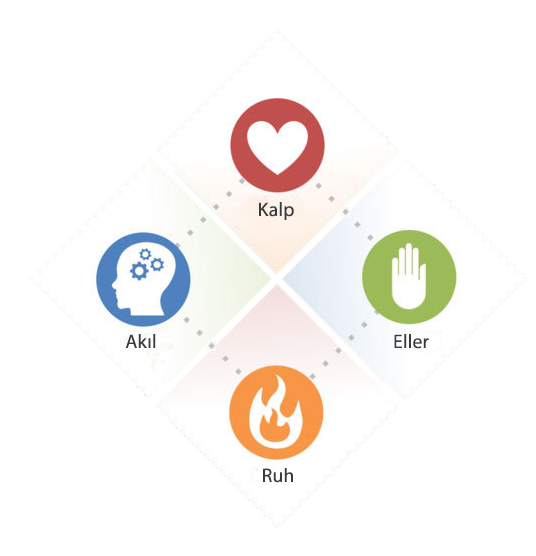
Heart is about meaning, passion and fulfillment, even finding joy in what you do. Soul is about attitude, energy and excitement. This is something you can feel when you walk into a room with or work with a highly engaged team. Heart and soul means that we need to feel what we do. Unfortunately, this is where most models of employee engagement stop and this is a mistake. There is more to engagement than just "feeling something".
The intellect is about intelligence, interests, curiosity and creativity. Your hands are about your efforts, productivity and determination - using your skills and sweat of your brow to produce something of value. The intellect and hands mean that we have to do something. We have to take action to be fully engaged. Simply put:
Heart and Soul = Emotion
Mind and Hands = Action
Commitment requires us to put both our emotions and our actions on the table - our hearts, our souls, our minds and our hands. To be committed, we have to feel something and act on what we feel. If you take one of them away, there is no commitment left. You can think of emotions and actions as the two oars of a boat.They are complementary opposites. Both are necessary. If you row with only one, you will keep going in circles. Using one may make you sweat and you may feel like you are getting somewhere, but you are not. If you row with both at the same time, you will move forward.
"You can't have one without the other"
We see this kind of wasted effort in many of the so-called employee experience initiatives in organizations. While well-intentioned, most of these initiatives try to go with only one shovel. Some organizations aim for the heart and soul, others for the mind and hands, but few organizations cover them all simultaneously. And what happens as a result? A lot of energy is expended, but little progress is made.
 Sometimes leaders make the mistake of thinking that if their people put enough effort into one shovel, the other shovel will pick up the slack. A good example of this is what happened in our recent work with a large company that acquired a formidable competitor... The acquirer had very professionally and effectively communicated to the employees of both companies the steps of the acquisition, the rationale behind it, and the steps that needed to take place in the coming months. The employees clearly understood that their minds and hands would be needed to make the integration process smooth, and they knew that it was financially beneficial for the company as a whole. On paper, everything looked very solid. Yet the integration failed miserably.
It soon became clear that while the minds and hands were active, the hearts and souls were lifeless. In our survey of employees, we realized that although they were activated, they didn't feel it. In short, this change in the company was not fully embraced by the employees. Even though the process was very concrete and clearly explained, the acquiring company failed to see that almost a quarter of their employees felt that the integration process would most likely result in the loss of their jobs.
Even more damaging to the integration was something else. Employees of the acquiring parent felt that the culture of the acquired company was one of "cutthroat competition". Because they felt this way, they too contributed to the toxicity of the environment. They made little effort to put their hearts and souls into the process, and so the acquisition was doomed to lose from the start.
At the other extreme, we've also worked with a number of organizations that put a lot of effort into engaging hearts and souls, but failed to engage minds and hands. These companies made great strides in energizing and even inspiring passion in their employees, but just because employees felt good about themselves didn't mean they took action. These companies put a lot of effort and money into building what they thought was a culture of engagement, but in reality they became companies that only felt good about themselves.

When you engage hearts, souls, minds and hands, those in your organization both feel and act. You have an engaged workforce that makes its own fundamental improvements in staff turnover, quality, customer service and profitability. You don't have to define and design the business results you can achieve based on engagement; with high engagement, great results are inevitable.
For more on Employee Engagement:
[i] Teresa Amabile, Steven Kramer, "Do Happier People Work Harder?", New York Times Sunday Review, September 3, 2011.
Related Articles