







 Chat
Chat


The following text is an excerpt from the book "Engagement MAGIC: 5 Tricks to Keep People, Leaders and Organizations Engaged".
In the fall of 2014, we launched the book MAGIC: Five Tricks to Employee Engagement. But the genesis of the book didn't actually start in those years. It started almost 20 years ago, when Decision Wise conducted its first employee engagement survey.

In those years, the concept of "employee engagement" was unknown. Companies were just beginning to understand the idea of employee satisfaction, and perhaps satisfaction had implications for the resulting employee and customer experience. If it really did, then wouldn't it make sense to measure how employees felt? And so, the employee survey started to take hold.
Over the next 10 years, as our company dove neck-deep into employee survey administration and data, themes began to emerge. First, it was clear that employee engagement impacts the bottom line. There is no doubt that organizations with higher levels of employee engagement tend to outperform other organizations on financial measures, customer service, employee retention, quality, innovation and many of the other key performance indicators.
Second, an excellent customer experience (CX) was the direct result of a superior employee experience (EX). Therefore, if an organization wants to improve customer satisfaction, it has to start with the employee experience first. My colleague Matthew Wride and I focused a lot on this concept in our book The Employee Experience: How to Attract Talent, Retain Top Performers, and Drive Results, which was a huge success and bestseller in large part because the EX = CX concept we introduced resonated with organizations.
Third, we discovered that engagement is a personal competence, which means that employee engagement can be learned, practiced, taught, measured. In fact, our findings showed that organizations can expect engagement from employees and managers and at the same time hold them accountable for it. All this meant that employee engagement is not simply a feeling, it requires action. A feeling without action is just a feeling. But feelings are not outcomes, and organizations don't hire people just to feel. Employee engagement involves both feeling and acting and results.

In 2014, our research database consisted of 14 million employee survey responses. In the last 4 years, this database had more than doubled with more than 32 million survey responses. That's a lot of data! Which brings us to the final point
With the doubling of the research database, the idea that the concepts in the first book, namely the tricks of employee engagement, could be explained by the acronym MAGIC, was repeatedly confirmed both by the research and by the practical experience of our clients.
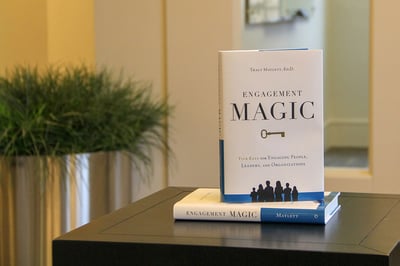
In 2018, DecisionWise completed another chapter in its journey to understand employee engagement and brought this updated research to a new book, Engagement MAGIC. Written as an update to the first book and incorporating these new findings, Engagement MAGIC offers updated case studies, stories, examples and research. I am sure you will see these tricks as a basis for exploring your personal and organizational engagement.

Related Articles