







 Chat
Chat


We live in challenging times. Geopolitical upheavals, regional and national social unrest, repeated deadly natural disasters, cyber-attacks, growing distrust of media and technology companies... Disruptive events like these always catch us by surprise.
Nearly two decades ago, military planners created an acronym to summarize the nature of an increasingly unpredictable and dynamic world. They called it VUCA : Volatility, Uncertainty, Complexity and Ambiguity.
In today's world, VUCA is more embodied than in any previous era.
Why is it that so many of us - individually and collectively - are failing to imagine, let alone anticipate, the massive and disruptive changes that are taking place? The pace of change, accelerated by rapidly advancing technologies and globalization, is accelerating, our brains are struggling to keep up, and the result is confusion, discomfort and unease.
This is not abnormal. Instead of slowing down, change will accelerate. To thrive in a world where "the only constant is change", leaders need to reframe old ways of thinking.
Exponential change demandsexponential leaders. But what does this mean?
In this article, we explore the four pillars of exponential leadership. These are important skills that leaders need to learn in order to successfully navigate a rapidly changing world. Not just to give their organizations a strategic advantage, but to create the inclusive, equitable, positive and abundant future we all want to live in.
Some leaders are already very advanced in some of these skills. An exponential leader aims to develop all of these, understands how they influence each other, and uses them in practice as a whole that is much stronger than its parts.
Futurist
The first skill of exponential leadership is to learn to transform surprise into informed foresight. For this, leaders need to become skillful futurists.
This does not simply mean projecting today's pace of change into the future. It means envisioning new possibilities with courage and optimism - and recognizing that they will likely materialize faster than expected. Leaders also need to feel comfortable with what is knowable and with exploring the unknown.
Many leaders do not currently do so.
Today, leaders often manage risks through a variety of analytical processes and frameworks that identify and measure known variables. In most organizations, the future is predicted mainly through numerical forecasts and tables, fostering the view that the world is an extension of what we know today, and that we need only enter a numerical formula to make quantifiable predictions.
The problem, however, is that these predictions are based on understanding current variables and trends. We see future events as a new form of past events and assume that the rate of change will proceed in a straight line. In reality, this line curves upwards and new variables - for example, unexpected technologies - are always introduced into the equation.
The result? Predictions fall short. At best we are surprised, at worst we are devastated.
We are not incapable of creating new narratives of the future in our heads, or increasing the number of possible futures we consider. But we have never learned to do this as part of our "work", nor have we ever been allowed to.
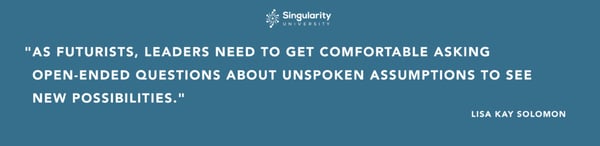
Futurist leaders must get into the habit of asking open-ended questions about unspoken assumptions to see new possibilities. It should be curious about the future and combine creative strategic forecasting practices, reverse forecasting, sci-fi design and scenario planning with traditional business planning.
Innovative
In addition to imagining a series of new futures, leaders must also act as inventors, discovering new ideas through creative ideation and intense experimentation. These days, great product ideas can be born from a single tweetor a surprising customer interaction, and a working prototype can be tested in less than 24 hours.
Yet many organizations are primarily looking to get existing products to market faster, while simultaneously reducing costs and increasing margins.
The underlying strategy is to bet on certainty while minimizing variability. And if successful, the focus shifts to defending and growing what is already in place, rather than seeking new opportunities through continuous exploration.
What is often missing here is a deep understanding of the customer at the other end of the process, as well as investment in designing and developing new products and services that meet emerging customer needs and demands.
When leaders embrace their innovation role, they realize that they must keep the customer in mind. They use human-centered processes such as observation and questioning to gather information; they use visual thinking and storytelling skills to share hypotheses and ideas quickly and effectively; and they adopt a growth mindset to test and validate what they learn.
Rigorous innovators do this over and over again to uncover opportunities behind the fog of uncertainty.
Technologist
As technological innovation advances, it is imperative for leaders to understand which technologies will directly impact their industry and which will impact neighboring industries. As technology increasingly digitizes, drives and replaces physical products and services, the status quo for many companies is being shaken.
The best way to understand technological change is not to read about it, but to experience it first-hand, such as learning to code to build and use a simple robot, to experiment with products and services other than those we are used to and feel comfortable with, and to seek resources to innovate and experiment.
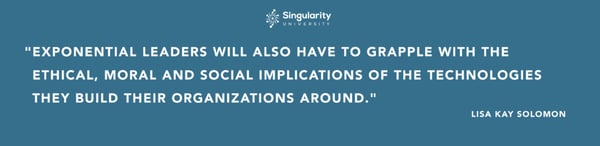
But it is not enough to understand technology only from an engineering or R&D perspective. Exponential leaders must also deal with the moral and social implications of the technologies around which they build their organizations.
Technological disruption overrides existing legislation, laws and social norms. Already there are tax and labor disputes between industry disruptors like Airbnb and Uber and the communities they serve.
But these legal battles pale in comparison to the moral struggles we will soon face when autonomous systems replace workers in large industries like food or transportation. We have not even begun to explore the possible consequences of a future in which genetic manipulation becomes increasingly accessible and widespread.
Politics and morality are not independent of technology, and technology does not happen in a compartment insulated from either. Leaders need to consider the huge new revenue potential or cost-saving opportunities that technology offers, and embrace the social and moral implications that will inevitably follow.
This will require a whole new set of discussions and decisions on corporate boards, new behaviors and norms in every product development lab, and new ways to train, reward (and even punish) tomorrow's leaders.
Humanitarian
Exponential leaders use their futuristic, innovative and technological skills and behaviors to improve the lives of the people they touch and society at large. They aim to succeed by doing good, not as a separate set of "corporate social responsibility" activities, but as part of an integrated company mission.
Being a humanitarian manager can mean using technology to build the business in a way that has a clearly positive impact. For example, B Corps are for-profit companies that are certified to meet rigorous standards of social and environmental performance, accountability and transparency. It can also mean investing in humanitarian policies and practices that create a positive culture and meaningful work environment. A workplace that inspires employees and partners to fulfill their potential.
Technology can now also offer entirely new business models and growth opportunities, empowering more and more new regions of the world to become sustainable and autonomous centers of economic growth.
Whether it's Google's high-altitude balloons connecting the most rural and underdeveloped areas to universal high-speed internet, or drones carrying medical supplies after natural disasters, we can begin to envision a world where the most extreme resource empowered by technology is our imagination that makes anything possible.
Our Future Needs Exponential Leaders
The roles of futurist, innovator, technologist and humanitarian are interconnected and are strengthened when knowledge and insights flow between them. These four pillars are a holistic system of learning to imagine, create, capture and measure hidden value in an increasingly complex and dynamic world.
This is the essence of exponential leadership.
By practicing these new skills, leaders can develop not only their capacity to anticipate change, but also their capacity to make proactive choices that open the door to a more positive, productive future for their organization, community and the world.