






 Chat
Chat


The science fiction writer William Gibson famously said: "The future has already arrived; it's just not evenly distributed." How do we as leaders embrace elements of the future that have already arrived and those that are yet to come? The answer is: by thinking more like futurists.
In times of increasing change and complexity, it can be difficult to envision brave new futures with certainty. Our first strategies for thinking about the future often start with what we know, for example, projecting past results onto future performance, examining current competitors, or focusing on short-term results.
What is missing are systematic approaches to understanding and capitalizing on the unknown. This is why leaders must adopt the skills, habits and behaviors of futurists.
Futurists have no secret power to see the future. They don't have a magic 8-ball or a basket full of special fortune cookies. Futurists train themselves to question the status quo. They regularly scan external trends, neighboring sectors and decisive forces. They consider various points of view. And they tell bold stories about the future when there is no data to back them up.
The Value of Thinking Like a Futurist
We have been trained to think of the future as a linear extension of what we already know; we often perceive change as a 10 percent improvement (or deterioration) of what is already around us.
We think we understand the future. Our view of the future is so embedded in business plans, financial models and strategy discussions that leaders often don't bother to articulate the underlying assumptions. And when they do, they may realize that their plans for the future are based on uncertain variables or that their options are not unique.
The future lies in a wide range of possibilities, and they can become reality surprisingly quickly.
Technological, environmental and political changes are very likely to disrupt your business. How do you prepare for a different, even unimaginable future that is approaching much more quickly than anticipated?
This is where the methods commonly used by futurists can help you strengthen your plans. Acquired strategic foresight methods systematically scan, analyze, interrogate and project into the future that we intuitively think is possible.
Seeing Ahead Like a Futurist
The first step is to identify the most important and uncertain macro forces shaping your business. These generally fall into five basic categories: Social, technological, economic, environmental and political.
Under each category, there are a number of drivers and exogenous variables that can lead to very different futures.
For example, an insurance company might track variables related to human longevity (societal), technologies that are radically affecting the treatment of chronic health conditions (technological), the pace of change from traditional employee-driven work patterns to more independent short-term work (economic), the frequency and impact of natural disasters (environmental), and the government's stance on legislation and possible new laws (political).
Once these high-impact variables have been identified and prioritized, futurists gather a variety of inputs to understand the ways in which these variables might take shape over time. The further they go, the wider the range of possibilities becomes.
Futurists call this the cone of probability and carefully divide their predictions into four areas.
- What are the possible futures? This is what will happen as a result of all events.
- What are the preferred futures? This is what we want to happen.
- What are the plausible futures? This is what is most likely to happen.
- What are the plausible futures? This is the one that seems impossible, even if we believe in it.
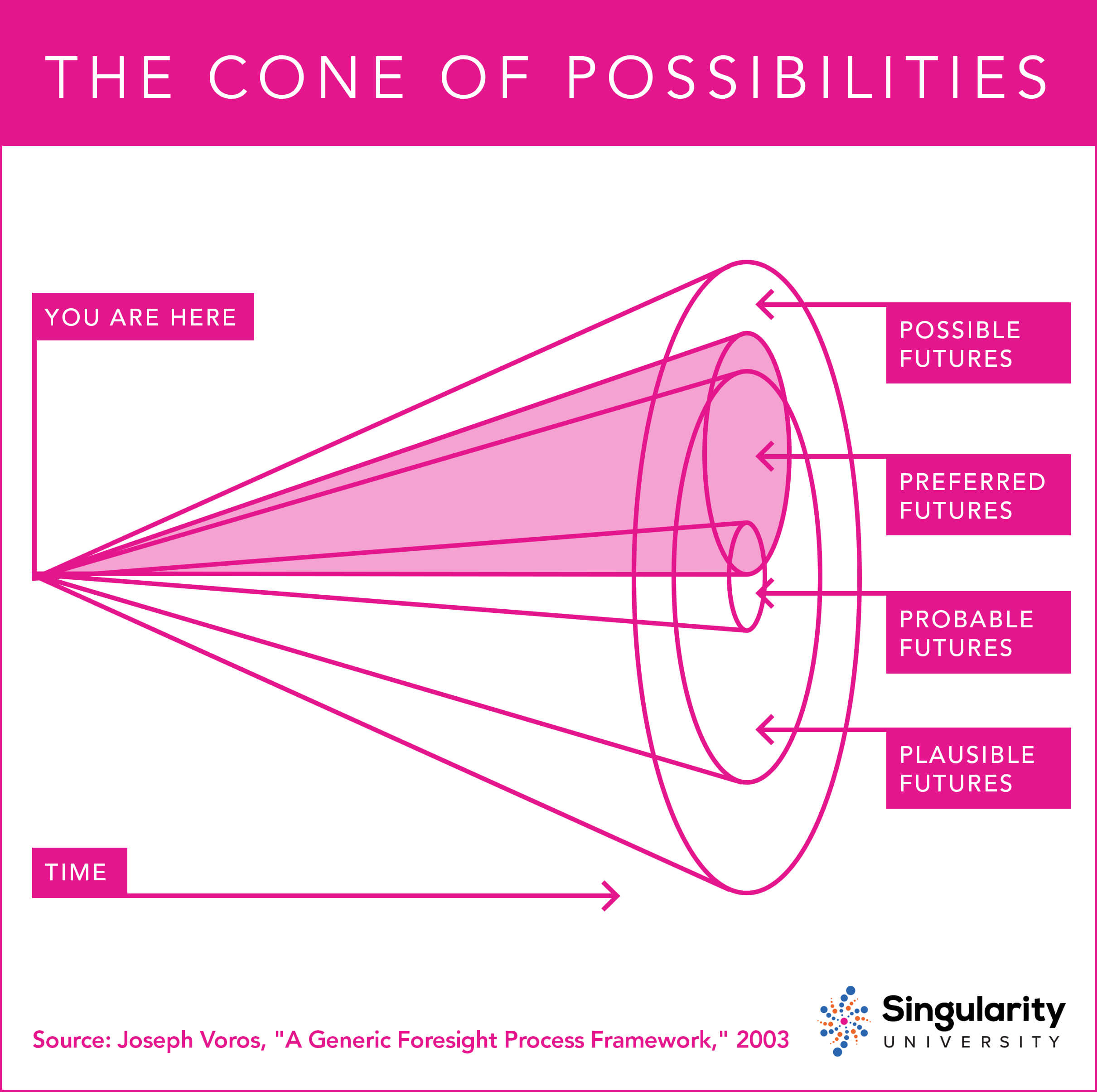
While these futures arise from a common set of specific variables, the outcomes are quite different.
This can be an illuminating strategic exercise for leaders: Could your organization be overemphasizing the desired future and neglecting other possible futures? If so, perhaps investment risks are not adequately balanced. Is your organization relying on the plausible future? You can broaden your horizons by researching new technologies, adjacent industries and start-ups to explore alternative strategic options.
Paul Saffo, Singularity University's Head of Futures Research and Foresight, repeatedly warns us that "the best hamburger is from sacred cows". One quick way to make your organization more future-focused is to ask your team to dive into their business networks and look for evidence of the key variables you have identified and hang them on an analog or digital wall.
How to Create Preferred Futures
Once you have identified what your preferred future is, you can begin to identify the key activities and milestones towards creating that future.
Backcasting is the act of imagining a preferred future and working backwards from there to the present, examining again and again what should have happened at each step.
Backcasting is not constrained by the limits of the current situation; it is focused on a desired future state. This allows people to write their own rich stories of the future and the discussion of "How can our product/service do this?" naturally begins.
To imagine bold new possibilities, visualize outcomes that are 10 times better, cheaper and more effective than what exists today. What if we all had access to personalized AI healthcare through sentient robots? Or if the majority of transportation services were provided by autonomous vehicles?
Now step back from these dreams and explore what it would take to make them a reality.
Like forward projections, backward projections can be improved by pursuing different inputs. For example, spend a few hours in a company-wide meeting designing "headlines from the future". Even just a few hours of collaboration can spark new thinking and spark fresh ideas. Exercises like this can also encourage interdisciplinary participation, creating a sense of collective responsibility.
Don't be afraid to be creative, or even to put away the PowerPoint slides. Kyle Nel, director of Lowe's Innovation Lab, uses narrative-driven innovation to envision new futures. Early on, Nel brought together sci-fi writers and illustrators to design comics that would show possible alternatives that went far beyond small, incremental changes, and that would allow the company's executives to envision the possible future of Lowe's in concrete terms.
Making Peace with Uncertainty
One of the hardest things about practicing the skills of a futurist is making peace with the fact that we cannot predict the future. For many senior executives, this is very uncomfortable. How can we make big bets on the future when we don't have all the data and information?
Most of us are uncomfortable with uncertainty and imprecision. Courageously looking ahead creates feelings of doubt, fear and anxiety that we prefer to keep in check. By constantly pushing ourselves to learn new things, to encounter new experiences and people, we can learn to cope with, and even enjoy, our discomfort with the unknown.
We can all become better futurists. In this way, we can not only build hope for new possibilities, but also create more flexible, adaptable and resilient organizations in the process.