







 Chat
Chat


This is the second in a four-part series looking at the big ideas in Ray Kurzweil's book in Ray Kurzweil's bookThe Singularity Is Near. Be sure to read the other articles:
"Technology is much more than making tools; it is essentially the process of creating even more powerful technologies using the tools from the previous innovation."
Ray Kurzweil
Fifteen years ago there were no smartphones (as they are called today). Thirty years ago nobody had a computer. Think about it: The first personal computers appeared about 40 years ago. Today, it seems like everyone is busy staring at a shiny handheld computer. (In fact, according to a Pew Report, two-thirds of Americans own a handheld computer.)
Intuitively, we feel that technology is advancing faster than ever. But is it really? According to Ray Kurzweil, it certainly is. In his book The Singularity Is Near, Kurzweil shows the increasing speed of technology and explains the driving force behind it all.
In this article, we explore how Kurzweil explains this driving force, which he calls the law of accelerating efficiency, and the surprising consequences of technological progress.
Moore's Law is famous - but not special
Computer chips are getting more powerful and less expensive. That's because the number of transistors - the tiny electrical components that perform basic operations - on a single chip has more than doubled in the last fifty years.
This exponential increase, known as Moore's Law, is why a modern smartphone can do so many dizzying things in so little space at such affordable prices.
Technological progress in computer chips is well known, but surprisingly, it is not a special case. A range of other technologies, whether it's bits of data being stored or DNA base pairs being recorded, are showing similar exponential growth. The results are the same: In a few decades, the amount of increased capabilities for lower costs is measured in thousands, millions, billions.
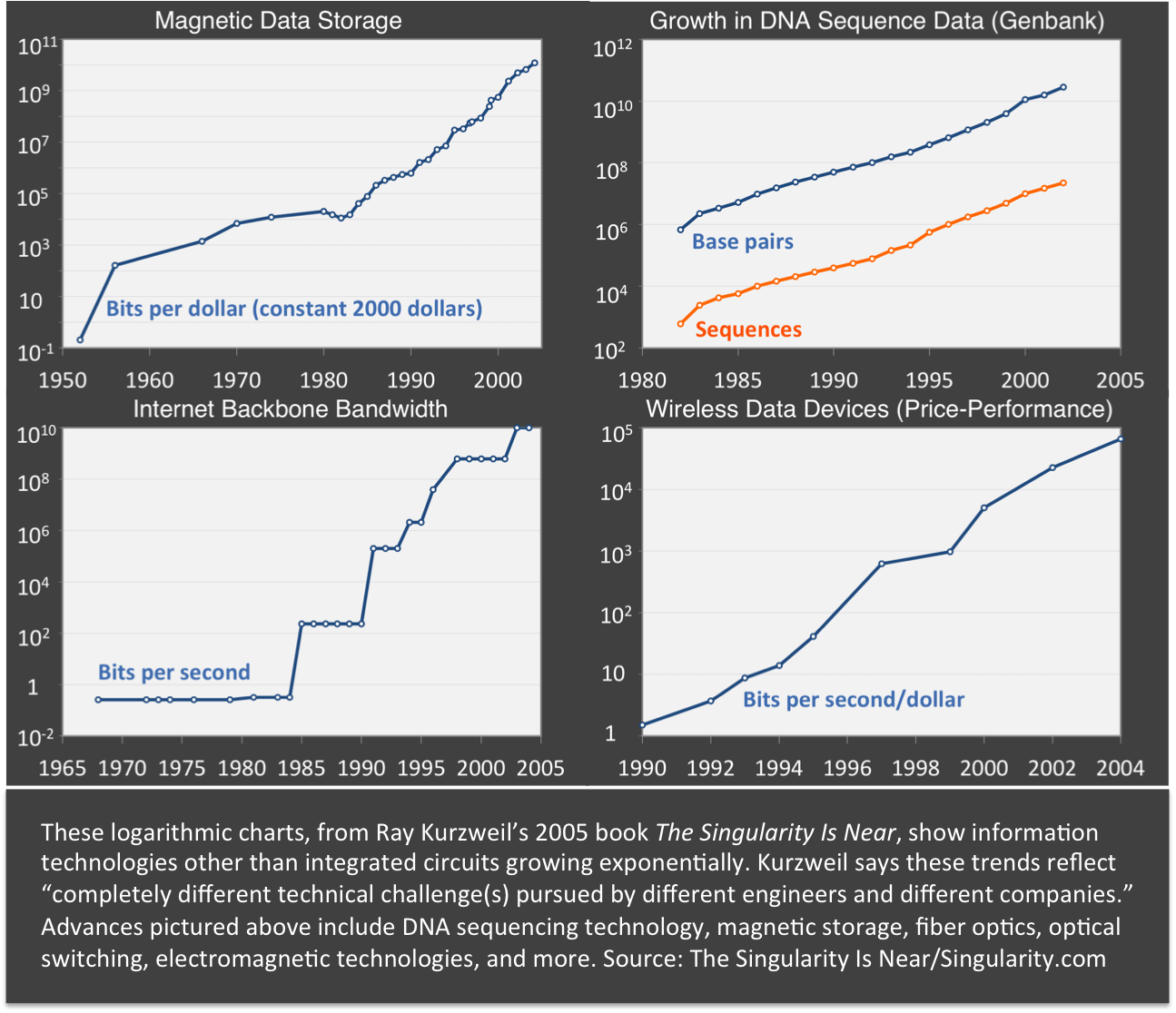
The graphs above are just a few examples of accelerating technologies, but there are many more. They are not directly based on a doubling of the number of transistors, but they all follow their own exponential curves, like computer chips.
So what is happening?
Accordingto the law of accelerating returns, the pace of technological progress - especially information technology - increases exponentially over time because its driving force is one we know well. It seems that exponential growth is all about evolution.
Technology is an evolutionary process
Let's start with the familiar evolutionary process of biology.
Biology, in a sense, sharpens natural "technologies". In the DNA of living things, templates of useful tools, called genes, are stored. Through selective pressure - or "survival of the fittest" - advantageous innovations are passed on to the next generation.
As this process repeats from generation to generation across geological time scales, chaotic, but little by little, incredible growth takes place. Rather than starting all over again, organisms that rely on genetic improvement have grown in complexity and capability over time. This innovative power is visible everywhere we look in the world today.
"Evolution gives positive feedback," Kurzweil writes. "More favorable methods that emerge in one stage of evolution are used to create the next stage."
Cells, bones, eyes, thumbs and the brain are some of the many innovations in biology; thumbs and the brain lead to technology. According to Kurzweil, technology, like biology, is an evolutionary process, but the transition from one invention to another is faster.
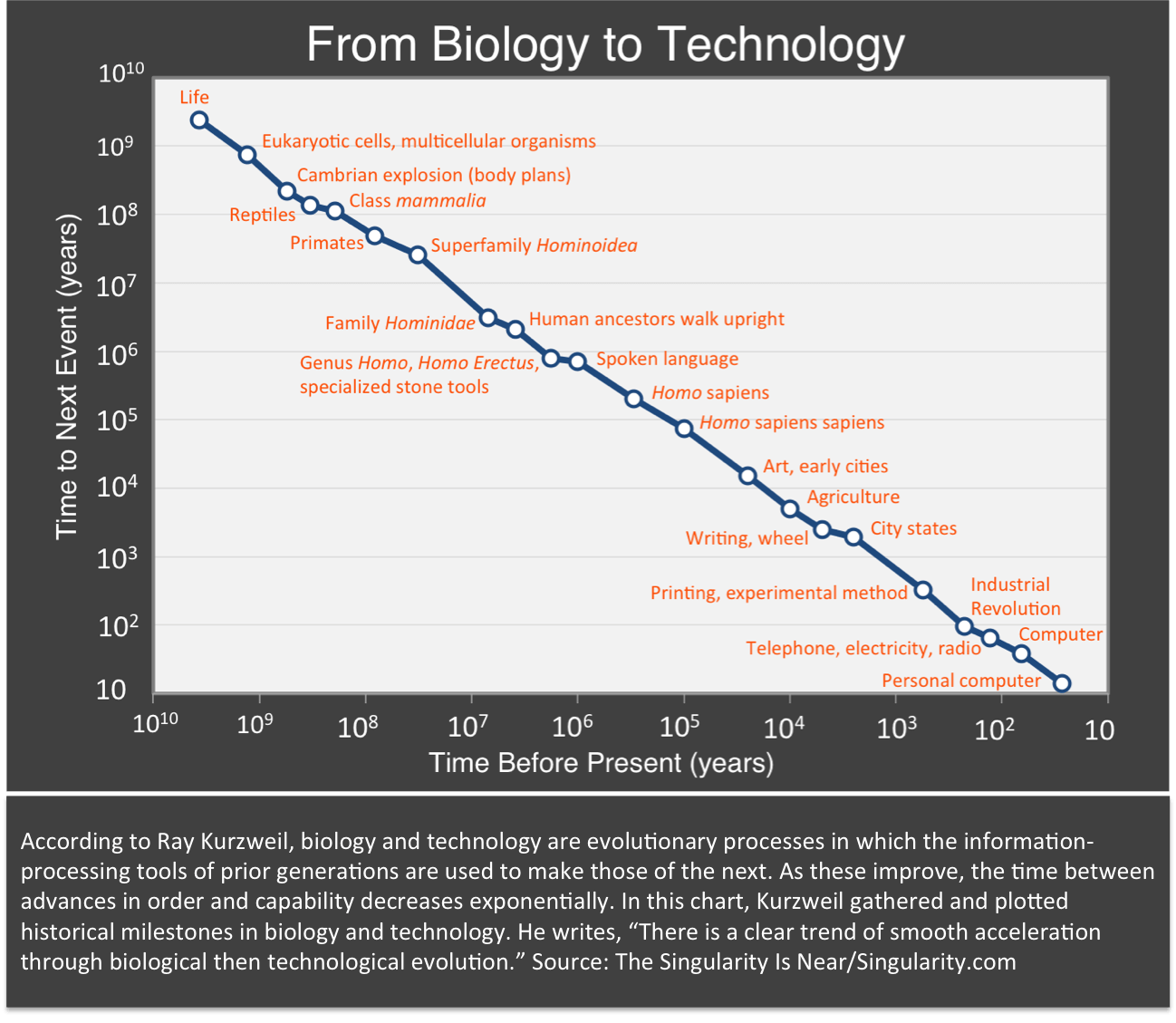
Civilizations advance by "repurposing" the ideas and inventions of those who came before them. In the same way, each generation of technology builds on the advances of its predecessors, creating a positive feedback loop of progress.
Kurzweil's key insight is that each generation of technology builds on the ones that came before it - so that advances in technology make the next generation of technology possible, new and better than the last.
The pace of technological evolution is increasing exponentially.
Because each generation of technology improves on the previous one, the rate of progress between versions increases a lot.
To understand this, imagine making a chair first with hand tools, then with power tools, then on an assembly line. Production gets a little faster at each step. Now imagine that each generation of these tools is also used to design and make better tools. Kurzweil suggests that such a process is at work in the software and computers used by engineers and in the design of ever faster computer chips.
"The first computers were designed on paper and built by hand. Today they are designed on computers, and the computers themselves work out many of the details of the next generation's design. They are then produced in fully automated factories with minimal human intervention."
Ray Kurzweil, The Singularity Is Near
This acceleration can be measured by the again exponentially increasing "outputs" of technology - speed, efficiency, price performance and overall "power".
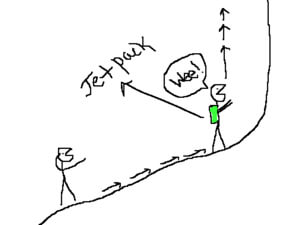
Acceleration of acceleration: It's like having a jetpack while climbing a mountain.
Moreover, as technology becomes more efficient, it attracts more attention. The result is a new flood of resources directed towards developing the technology further: Increasing R&D budgets, hiring the most competent people, etc.
As a result of the "second level" exponential growth triggered by this new wave of resources, exponential growth (power) also accelerates.
But specialized paradigms (e.g. integrated circuits) will not grow forever. They will grow until they fulfill their potential and then give way to a new paradigm.
The surprising consequences of the Law of Accelerating Productivity
Kurzweil wrote in 2001 that with the rate of progress doublingevery decade, "in the 21st century we will not see 100 years of progress - rather we will see 20,000 years of progress (at today's rate). "
This means that incredibly powerful technologies may be much closer than we think. Ray Kurzweil's predictions of the last 25 years may have sounded far-fetched at the time , but many of them have turned out to be right.
In 1990, for example, he predicted that a computer would beat a chess champion by 1998, and in 1997, Garry Kasparov lost to IBM's Deep Blue. (In 2016, a computer mastered the even more complex game of Go - a development that some experts did not expect for another decade.)
Only 19 years into the 21st century, the progress is fascinating - the global adoption of the internet, smartphones, ever more capable robots, learning artificial intelligence... We were able to sequence the first human genome in 2004 for hundreds of millions of dollars. Now machines can sequence18,000a year for $1,000 per genome.
These are just a few examples where the law of accelerating returns is driving progress. Since the future is approaching faster than we think, it is important to think "exponentially" about where we are heading and how we will get there.
To learn more about the exponential pace of technology and Ray Kurzweil's predictions, read his 2001 essay"The Law of Accelerating Returns" and his book, The Singularity Is Near.
Image Credit:Deposit
We are a participant in the Amazon Services LLC Associates Program, an affiliate advertising program designed to provide a means for us to earn fees by linking to Amazon.com and affiliated sites.
By Alison E. Berman and Jason Dorrier
This article originally appeared on Singularity Hub, a publication of Singularity University.
Related Articles



-2.jpeg)