







 WhatsApp


Feedback is a vital part of performance, growth and development. Understanding ourselves and how we interact with others helps us to understand the impact we have on those around us. The perceptions of others in our circle of influence determine our level of success, regardless of whether those perceptions are accurate or inaccurate. Regardless of the accuracy of these perceptions, our interactions with others both influence and are influenced by their perceptions. This is where 360-degree feedback comes in.
Based on the philosophy that individuals should take a 360-degree view of their performance by gaining multiple perspectives,multi-rater surveys gather information about an individual's performance and behaviors by gathering feedback from the stakeholders that the individual influences. Much like a 360-degree circle, an individual is figuratively at the center of the circle and feedback is collected through a survey from those in a position to observe that person in action (managers, subordinates, colleagues, customers, etc.).
The use of 360-degree feedback has increased significantly over the last two decades. Some estimates suggest that as many as 90% of Fortune 500 companies use some form of multi-evaluator feedback with their managers. However, the success of 360-degree feedback programs is highly variable. The question that arises is, "what makes a 360-degree feedback program successful versus programs that fail horribly?"
In the work of our partner DecisionWise researchers over the last decade, we have found some interesting facts about how to make the 360-degree feedback process more effective. Two areas stand out more than others: Coaching and Goal Setting.
RESEARCH STUDY #1
The first research on the effectiveness of 360-degree feedback was a two-year study of a group of 345 executives at a multinational technology firm. Each of these managers had participated in a 360-degree feedback assessment earlier that year. A total of four different 360 feedback surveys were used for this group, which means that they were not all assessed on the same 360 feedback tool. However, in each of the assessments, these managers received feedback from supervisors, subordinates and peers.
Six months after completing the 360-degree feedback survey, DecisionWise asked these managers to self-assess their perceptions of the effectiveness of the survey through an online survey. They were asked to rate the questions on two general statements:
1- Overall, I feel that the 360-degree feedback process was effective.
2- I made significant positive changes about myself as a result of the 360-degree feedback I received.
They were also asked to rate various stages of the process, such as whether the survey was simple to operate, whether they received coaching in the process, and whether they set goals based on the survey. The results of this survey were very revealing:
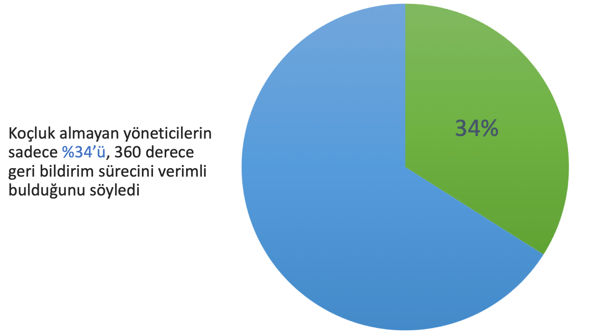
92% of those who received coaching reported that the entire 360-degree feedback process was effective. In contrast, only 34% of those who did not receive coaching felt that the process was effective.
For the purposes of this study, the interpretation of "coaching" is left to the scoring manager. For some it meant a simple briefing where they sat down with their supervisor, colleagues, mentors or an external coach to review the results. For others, the idea of coaching was deeper and involved longer coaching sessions. This was deliberately left to their interpretation as it was desirable to allow the participant to determine the level of coaching they needed to get the maximum benefit from the assessment.
RESEARCH STUDY #2
This study was followed up two years later and found almost the same results. This study went one step further and asked several evaluators (those who provided the initial feedback on these managers) whether they noticed changes in the behavior and performance of these managers after the 360 evaluation. The analysis of the results of the evaluators' answers showed that there was a clear correlation between the managers who self-evaluated themselves (the managers' ratings of this process and their own improvement) and the change reported by the evaluators of these managers. These correlations provide further support for the theory that coaching and goal setting significantly improve the outcome of a 360-degree feedback process.
Further analysis showed that when participants set clear goals to address 360 feedback areas, they reported a significant improvement in 360 feedback the following year compared to those who did not set goals. This finding adds to the theory that goal setting is the key to improvement in 360-degree processes.
Summary of Findings
The research revealed some interesting insights:
- 92% of those who responded positively to "I received adequate coaching" answered "In general, I think the 360 process is effective".
- 87% of goal setters think that the 360 process is effective.
- 94% of those who received coaching and 94% of those who set goals thought the 360 process was effective.
- Conversely, only 34%of those who did not receive adequate coaching thought the 360 process was effective.
- Less than 40% of those who did not receive coaching had set goals based on 360 feedback.
Only half of organizations provide 360 feedback coaching.
An interesting note - what we clearly notice in these studies is that less than half of the organizations using 360 feedback today emphasize coaching and goal setting as part of the process. This research leaves little doubt about the importance of coaching and goal setting in making the 360 process more effective, and shows that a large number of organizations doing 360 assessments can significantly increase their return on investment.
So, do you want to ensure that your feedback process is effective? Then add goal setting and coaching to your process. Because according to the research, these two factors play a key role in your leadership development process.
In short, without coaching and goal setting, your 360-degree feedback process is a waste of time and money.

OTHER CONTENT ON THIS TOPIC
Related Articles