







 WhatsApp


According to our survey of more than 950 people, 70 percent of employees are already facing a critical conversation with their boss, coworkers or subordinates.
According to the study, the number one person employees fear having a difficult conversation with is their manager, and the most common of these difficult conversations is not being able to talk directly with managers who are exhibiting poor behavior. Participants shared with us some examples of the four most difficult types of conversations at work, including bad behavior:
- Bad behavior:"Because I couldn't tell my manager, I had to tell the director that my manager was a bad leader and that his actions were causing long-term damage to the company.
- "Unpleasant behavior: "My coworker interfered in my personal life and criticized my children. She even said she didn't approve of the way my daughter dressed."
- Accusatory behavior: "A senior manager in the company accused me of altering a document he had signed, saying that I had changed it later."
- Performance appraisal : "I had to explain to a person with asthma that his intentions and actions were not well received by other employees and that his credibility would suffer if he continued on this path."
RESEARCH FINDINGS
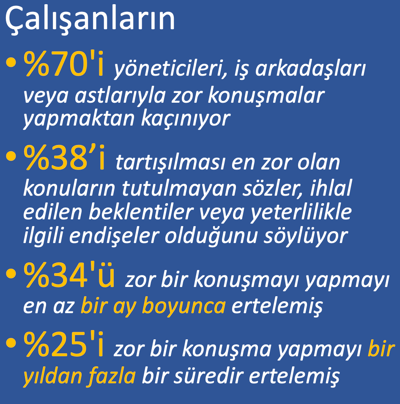
The study also found that 34 percent of workers put off having a difficult conversation for at least a month, and nearly a quarter put it off for more than a year. Common methods of escaping the situation include avoiding the person involved, dancing around the issue, and even quitting. One participant even said that she rushed to the women's restroom to avoid the person she needed to have a difficult conversation with.
What's more, these conversations are not only difficult, they are destructive. According to the survey, people who are "insufficiently confident" in their ability to carry out a difficult conversation are 59 percent more likely to show low productivity at work, 96 percent more likely to have low morale, and 86 percent more likely to be in a poor work environment.
TIPS for Difficult Conversations
- Talk face to face and in private. Don't run scared, taking refuge in email or the phone.
-
Hope for the best from other people. They may not realize what they are doing. Start the conversation as a friend who wants to learn instead of an angry coworker.
-
Use hypothetical language. Start describing the problem by saying, "I'm not sure that was your original intention..." or "I'm not even sure you realize...".
- Share facts, not conclusions. Not only are your conclusions probably wrong, but they also create a defensive attitude in the other person. "You laughed at my suggestion in the last two meetings. I expect people to disagree, but I don't understand why you laughed?"
-
Ask for other people's opinions. Then ask if they see the problem differently. You are now ready to have a healthy conversation about bad behavior.
-
Show equal treatment. These skills apply to both managers and coworkers. Everyone should be treated as a reasonable and rational person who deserves your respect.
CRITICAL CONVERSATIONS TRAINING


Related Articles