







 WhatsApp


We have been coaching on 360-degree feedback surveys and their results for a long time. Over that time, we've found the best ways to use 360 surveys in a way that gets the most bang for your buck while avoiding the most common pitfalls.
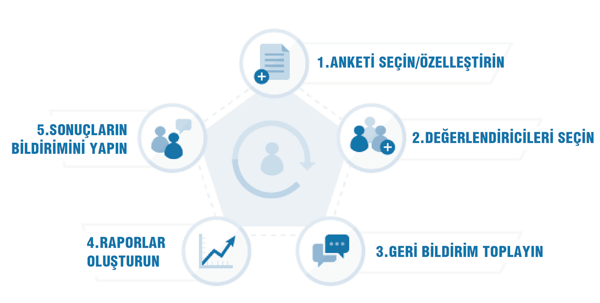
This content provides advice on the entire process from start to finish for organizations looking to implement the process, as well as for organizations that have been implementing 360 surveys for years. The information here is organized according to the 12 most common questions asked by our customers:
- How does 360 degree feedback benefit a leader?
- What needs to be measured?
- How do you evaluate those who derail leadership?
- Which assessment scale works best?
- What is the best way to collect qualitative data?
- How should evaluators be selected?
- Should I participate in my own 360 survey?
- How do evaluators provide useful feedback?
- How can the feedback process be kept confidential?
- Who should see the 360 feedback report?
- What is the most effective coaching process?
- What is the best way to keep in touch with evaluators?
How does 360-degree feedback benefit a leader?
.jpg?width=300&name=zeminli%20(1).jpg) Some leaders question the idea of running a formal 360-degree feedback process. They might say, "If I want feedback from other people, I'll go to them and ask them." The problem is that most leaders don't ask for the feedback they need, and if they do, it's not as honest or comprehensive as when people give 360 survey feedback. Evaluations with multiple raters provide a safe way for other people to provide open and honest feedback on a wide range of leadership competencies and behaviors of the person being evaluated. It reduces the emotional and political barriers people feel about providing constructive information about a manager or colleague.
Some leaders question the idea of running a formal 360-degree feedback process. They might say, "If I want feedback from other people, I'll go to them and ask them." The problem is that most leaders don't ask for the feedback they need, and if they do, it's not as honest or comprehensive as when people give 360 survey feedback. Evaluations with multiple raters provide a safe way for other people to provide open and honest feedback on a wide range of leadership competencies and behaviors of the person being evaluated. It reduces the emotional and political barriers people feel about providing constructive information about a manager or colleague.
Sometimes the fear of the unknown intimidates people who want to start the process. "What if people use the 360-feedback process to get back at me?" they ask. The truth is that people don't use the feedback process maliciously. On the contrary, they understand that by providing feedback they are investing in the leader's development and are more willing to provide support.
What needs to be measured?
Well-structured 360 surveys are great for measuring against specific leadership competencies and behaviors that are critical to an individual's success (or failure). Most surveys have 8-12 competency areas with a total of 60-80 specific behavioral statements that need to be scored.
We also recommend using a short section to assess leadership derailers, which are harmful behaviors that negatively impact leadership success. Read the survey items to make sure they are relevant to leaders in your organization.
Having said that, it's worth noting that organizations often come to an interesting crossroads when choosing a survey: the decision to use a standard 360 survey or to tailor the survey to specific leadership competencies that are unique to the organization.
- Adapted/Customized 360 surveys are recommended for organizations that already have leadership competencies identified and want to provide feedback to all their leaders. Various versions of the 360 survey can be developed for different levels of leaders (from senior managers to team leaders). This option costs more, but provides a fit-for-purpose tool that can be used for years.
- Standard 360 surveys are great because they are tested and validated, provide benchmark comparisons and generally measure a wide range of leadership competencies. With no customization fees, a standard survey is a good option for small groups or for organizations without a formal competency model.
But what about leadership derailers?
We recommend using a group of 10-12 derailers like the ones above and similar as a separate section of the questionnaire, as the statements here are said negatively and the rating scale is different. The derailers section helps to identify bad behavior that may not occur in other competence areas. It also helps to identify patterns in feedback. For example, if leaders tend towards over-intervention (micromanagement) or perfectionism, they also tend to score high on results orientation or planning and organization.
Which evaluation scale works best?
For 360-degree feedback surveys, we recommend using a seven-point Likert scale. Why? Because a seven-point scale offers a wider range of responses and makes it easier to see differences in perceptions between groups of evaluators.
What is the best way to collect qualitative data?
We recommend using two or three open-ended questions at the end of the questionnaire to collect comments. Since each open-ended question adds two minutes to the survey completion time, more than three questions tends to lead to rater fatigue and abandonment.
We have found that two or three open-ended questions still provide a lot of feedback and help clarify quantitative responses. Here are two questions we like to use:
- Describe the person's greatest strengths as a leader.
- Identify specific things this person could do to be a more effective leader.
How should the evaluators be selected?
We recommend that the participant (the one receiving the feedback) is involved in deciding who will be asked to participate in the survey. This makes the person feel more connected to the process and accepting of the results. Ideally, the participant meets with their manager to create a list of evaluators and the manager gives the final approval. If the participant is not involved in the selection of evaluators, they are more likely to disregard the survey results.
We recommend selecting a total of 8 to 15 evaluators, consisting of groups of at least 3 evaluators. Groups of evaluators usually include:
- Manager (boss)
- Himself
- Subordinates
- Colleagues
- Others
Even if it is a large group, make sure to include all direct reports. That way no one feels excluded from the process.
Do I need to participate in my own 360 survey?
Yes please! Unless you take your own survey, you cannot compare your perception of yourself with that of others. Seeing the contradictions between how your manager, colleagues and subordinates see you and how you see yourself is the most eye-opening and developmental aspect of 360-degree feedback.
How do evaluators provide useful feedback?
Evaluators (those providing the feedback) should always get some guidelines on how to give good feedback. Doing so helps to alleviate concerns about the process and ensure that the feedback is constructive and useful for the participant. Feedback should be relevant and actionable. When preparing assessors to provide feedback, ask them to do the following:
- Be respectful
- Speak for yourself
- Answer only the questions asked
Also make it clear that their answers will be kept confidential and that averages are taken as a group. No individual scores are shown in the report except those provided by the manager and the participant.
How can the feedback process be kept confidential?
Confidentiality is the most important part of the 360-degree feedback process. To collect honest and sincere feedback, evaluators need to make sure that their feedback will be kept anonymous. Here are the best ways to protect privacy:
- Set expectations: Communicate how the process will work, who will participate in the evaluation and who will see the results.
- Outsource: When you conduct the 360 feedback process in-house using an online software tool, employees are more likely to believe that their responses will be visible to HR or their managers.
- Select a sufficient number of raters: Make sure you have enough raters in each rater group to provide a combined total score. We recommend at least two responses from each rater group to show the actual results. This means that each group should have at least three raters in case one person does not respond.
Who (other than the participant) should see the 360 feedback report?
If you are using a 360-degree feedback for the first time in your organization, we recommend that the individual report is only available to the participant and a coach (internal or external). This will help reduce confidentiality and fear that the results will be used in a criminal way.
To ensure accountability, set the expectation that at the end of the process, the participant should meet with their manager to create an action plan. In subsequent years, if you will share individual reports with the manager or others in HR, inform everyone involved.
What is the most effective coaching process?
With 360 feedback, we can't say enough about the importance of coaching. Our research shows that 94 percent of those who receive coaching and set goals feel that the feedback process is effective. In contrast, only 34 percent think the process is effective when they are not coached.
Ideally, the participant should have a meeting of about 90 minutes with an internal or external coach to review the results and create a personal action plan. This ensures that the feedback is interpreted correctly by the participant and that they have an accountability partner to discuss their ideas with. The coach can help the person to process their feelings and gain clarity on how they are perceived by others.
What is the best way to stay in touch with evaluators?
When others give feedback using a 360-degree questionnaire, they are involved in the participant's development process. They invest time, energy and thought into the feedback they give. It is therefore important for the participant to thank the assessors for their feedback, acknowledge what worked and what did not work and ask for help in achieving their development goals.
Assessors are more likely to continue to support the person's development when they are personally asked to do so; they have seen that the person has acted on their feedback and then stayed in touch with them, fulfilling their commitments.
Final thoughts
Honest and trustworthy feedback is essential for testing one's own perceptions, recognizing strengths that were previously unrecognized, and becoming aware of blind spots in one's perception of oneself. This new self-awareness acts as a catalyst to promote personal growth and change. The output of the process is to create a personal development action plan.
In conclusion, 360-degree feedback is the best way to start a personal development journey, change habits, improve relationships with others and become a better leader.
Related Articles