







 Chat
Chat


"The 6 Ds is a chain reaction of technological progress; a roadmap for rapid development that always leads to enormous change and opportunity."
-Peter Diamandis and Steven Kotler, Bold
We live in an incredible age. News travels around the world in a second. Music, movies, games, communication and information are always at our fingertips, on our constantly connected devices. From biotechnology to artificial intelligence, powerful technologies that were once only accessible to large corporations and governments are increasingly accessible and affordable thanks to digitalization.
The potential for entrepreneurs to suddenly disrupt industries and large companies has never been greater.
A hundred, fifty, even twenty years ago, disruption meant creating a product or service that people needed but didn't yet have, and then producing it better and cheaper than your competitors. It meant hiring hundreds or thousands of staff, finding a large physical space to put them in, and waiting for years, even decades, to reap the fruits of your hard work.
"Technology is disrupting traditional industrial processes and there is no going back."
But thanks to digital technologies developing at an exponential rate of change, the landscape of 21st century business is radically changing.
The structure of companies is changing. Instead of maintaining thousands of employees and large physical facilities, modern startups are small organizations that focus on information technology. By dematerializing what was once physical, they create new products and revenue streams in months or even weeks.
You no longer need to be a big company to make a big impact.
Technology is disrupting traditional industrial processes and there is no going back. This disruption opens up new opportunities for progressive entrepreneurs.
The way to positively impact the lives of millions of people is to understand and internalize the life cycle of digital technologies. This cycle unfolds in six main steps, which Peter Diamandis calls the 6 Ds of Exponentiality: Digitization, deception, subversion, demonetization, dematerialization and democratization.
According to Diamandis, co-founder and executive chairman ofSingularity University, and founder and executive chairman of XPRIZE , when something is digitized, it starts to function like information technology.
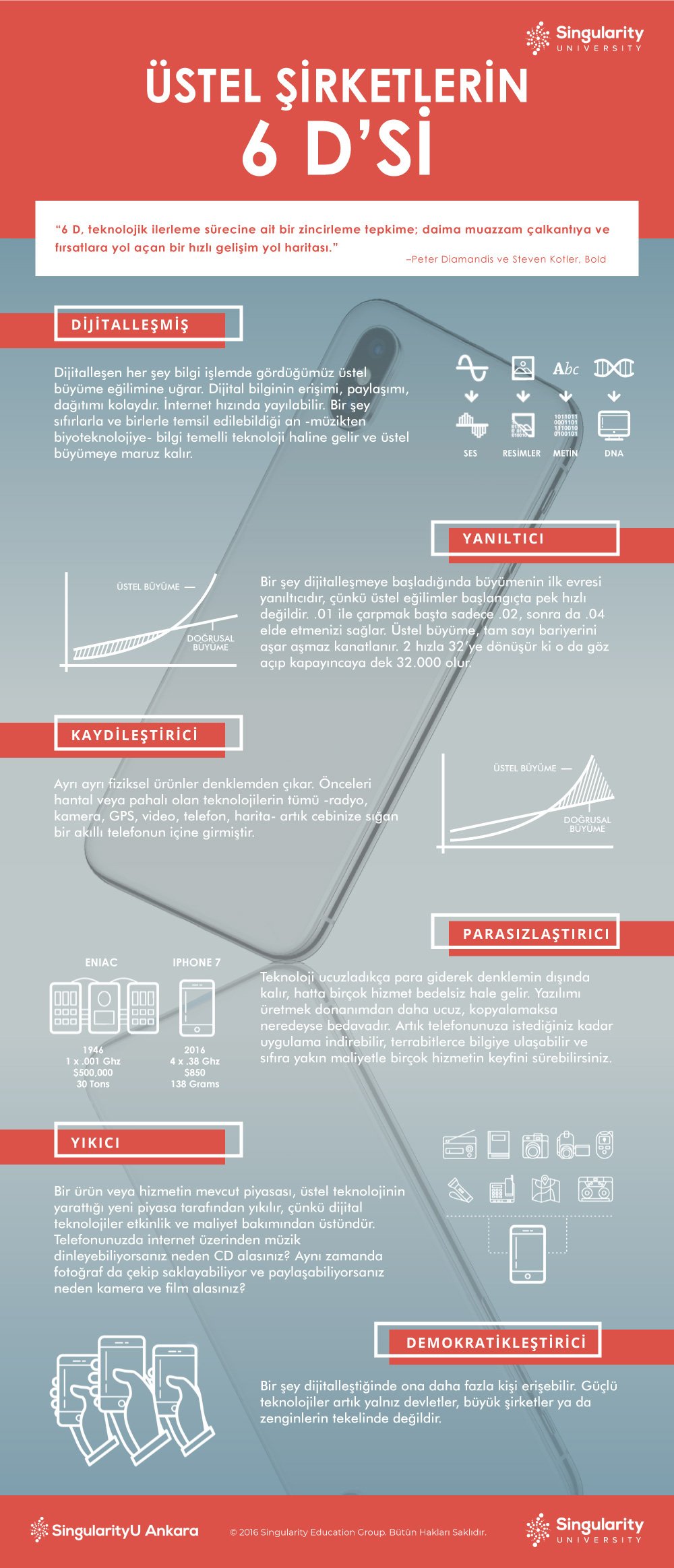
New digitized products are evolving not at a linear pace, but at an exponential rate, surprising those who witness them and disrupting companies and industries. Before you know it, something that was once expensive and physical has turned into a penny-pinching app.
Newspapers and CDs are the best-known recent examples. The entertainment and media industries are still trying to cope with the consequences of digitization by transforming and updating practices from a bygone era. But digital media is only the beginning. As the economy digitizes, all sectors - from medicine to manufacturing - will be similarly disrupted in an exponential curve.
Diamandis' 6 D's are vital to understanding and planning for this destruction.
Peter D's "6 D's of Exponentials" from Singularity University on Vimeo.
Diamandis uses the contrasting fates of Kodak and Instagram to illustrate the power of the 6 D's and exponential thinking.
Kodak, which invented the digital camera in 1975, did not invest much in this new technology and stuck with what was familiar: traditional cameras and film. In 1996, Kodak had a market capitalization of $28 billion and 95,000 employees.
But the company didn't pay enough attention to how the digitization of its business was changing things. People were no longer taking photos in the same way and for the same reasons.
After a rapid decline, Kodak went bankrupt in 2012. That same year, Facebook bought Instagram, a digital photo-sharing app from a startup with 13 employees at the time. The price tag was $1 billion. And Instagram had only been around for 18 months.
The most ironic part of this story is that Kodak invented the digital camera, took the first step to overhaul the photography industry and bring it into the modern age, but was reluctant to take a risk in uncharted territory and disrupt its existing business. So others did it for him.
The same can happen with any technology that is just starting to find its feet. In the initial phase of the exponential curve, when progress seems slow, it is easy to let it go. But to give up is to leave the opportunity in someone else's hands.
The 6 Ds is a roadmap of what can happen when an exponential technology is born. Not every step is easy, but the results give even small teams the ability to change the world faster and more effectively than traditional companies.
Translation Success Program